17 February 2012

Xbox 720 console code-named 'Durango'


Xbox 720, Xbox Loop, neXt-box.  We've heard all the rumored names for Microsoft's next-gen Xbox console.  Except for one.
Kotaku has heard from "multiple sources close to the project" that Microsoft's next Xbox console (what we've been calling the Xbox 720) will be code-named "Durango".
By far the least entertaining of the rumors we've heard surrounding the Xbox 720, this could be the most informative if true.  You see, the Xbox "Durango" won't be the finished product name, but it will be the name you will hear most often during the console's final development phase - the time when Microsoft announces the console until it ships.Also expected is that the Durango will have strong voice and motion controls like the Xbox 360 Kinect, and it will have a much stronger approach to 3D content. Some also predict it will allow players to play online games for free, and employ a premium service similar to Sony's Playstation Plus.
Of course, who knows when that will actually begin.  Despite rumors that the Xbox Durango (or Xbox 720) is already being worked on, Microsoft has denied all rumors of a next-gen console announcement, most recently squashing the E3 2012 reveal rumor.
Durango doesn't necessarily mean anything as far as the system is concerned.  It's just a name.  Microsoft's Xbox Kinect was code-named Project Natal before being named "Kinect".


Source:Gamezone
08 February 2012

Microsoft OneNote Now Available for Android

Word, Excel, and PowerPoint may get all the attention, but OneNote has quickly become the gem of the Microsoft Office suite. Microsoft is now extending the reach of OneNote with an app for Android smartphones and tablets.

OneNote Mobile for AndroidA post on the Microsoft OneNote Blog exclaims, “For all of you who've been asking (and patiently waiting) for a version of OneNote for your Android phones, we have great news: OneNote Mobile for Android is now available!”
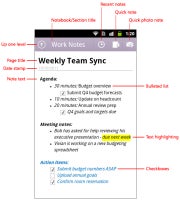
A breakdown of key features of the OneNote Mobile for Android app.The Android app further extends the reach of OneNote. It is already part of the Windows version of the Microsoft Office suite, and it is available on Windows Phone, iPhone, and on iPad.
OneNote is arguably the most versatile product in the Microsoft Office lineup. You can make lists, track to-dos, take notes, organize information. You can also use it to manage projects and collaborate with others by sharing out notebooks you create.
OneNote Mobile for Android has similar features and capabilities to its app counterparts on Windows Phone and iOS. You can store and access OneNote notebooks, sync notes with Microsoft’s SkyDrive cloud service, and store notebooks for offline access. The app provides quick and easy access to your most recent notes, and allows you to embed pictures taken with the camera on your Android device within notes.
Whether you use OneNote personally, or as a project management or collaboration tool with others, the addition of the Android app is welcome. Many people have Windows PCs, an Android smartphone, and an iPad, or some similar cross-platform collection of devices. The value of OneNote is in being able to create, access, and edit the information contained in OneNote no matter what platform you are using at the time.
Like the iOS version, OneNote Mobile for Android is offered for free from Microsoft, but has a maximum limit of 500 notes. Once you hit the max, you will have to purchase the unlimited version for $4.99 or you will no longer be able to create or edit notes from the Android app. You will, however, still be capable of syncing and viewing the notes you have created on other platforms.

Source:PC World

07 February 2012

Is Facebook accurately counting its daily active users?

Facebook's monthly and daily active users increase rapidly, but a deeper analysis of those figures has revealed that they might not tell the whole story.

 The New York Times' Andrew Ross Sorkin last night published a column discussing the method with which Facebook measures daily active users.
"We define a daily active user as a registered Facebook user who logged in and visited Facebook through our website or a mobile device, or took

03 February 2012

The 16 Best Science Visualizations of 2011

Mouse Eyeball Cells
Toxic barbs on a cucumber’s skin, nanoscopic flakes of metal and a mouse’s technicolor eyeball (above) are just a few of 2011′s top science visualizations.
A panel of judges picked the best of more than 200 entries from 33 countries for the 2011 International Science and Engineering Visualization Challenge.
“I think because information technology tools and visualization tools have advanced, people have found ever-increasingly clever ways to display difficult scientific concepts,” said competition judge Thomas Wagner, a cryosphere scientist at NASA, in an interview provided by the contest.
Contest judges made their picks based on visual impact, originality and clarity. The winners, which include “people’s choice” awards as well as honorable mentions, were published online Feb. 2 in the journal Science.

11 January 2012

Lit Motors' C-1 electric motorcycle


As any avid biker will tell you, motorcycles have a lot of advantages over cars - they use less fuel, accelerate faster, are more maneuverable, can be parked in more places, and don't incorporate the weight of extra seating for passengers who are non-existent on solo commutes. As many other people will tell you, however, motorcycles also leave their occupants open to the rain and cold, and can potentially tip over and scatter those occupants across the road. That's where Lit Motors' C-1 comes into the picture. It's a proposed fully-enclosed two-passenger electric motorbike that uses an electronically-controlled gyroscopic stabilizing system to stay upright when stopped, or even when struck from the side in an accident.

10 January 2012

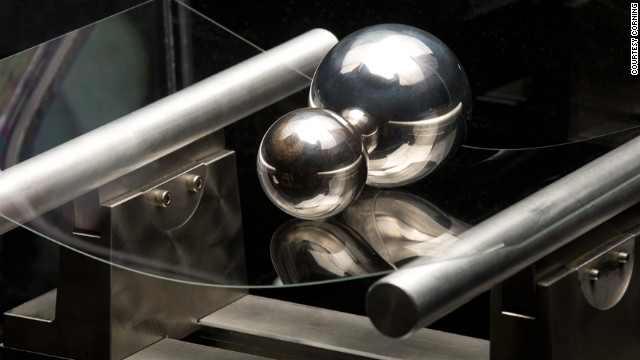
New glass could make touchscreens lighter, more responsive

The new Corning glass supports two steel balls, showing its strength and flexibility.

STORY HIGHLIGHTS
  • Corning unveils a new, thinner form of its popular Gorilla Glass at CES
  • The original Gorilla Glass is used in more than 500 models of touchscreen gadgets
  • New glass more responsive but not less resistant to breakage than current Gorilla Glass

Future Refrigerator

This is the In My Fridge project it is meant to simplify the process of food management by focusing on the technical & communicative aspects of the refrigerator. Using new RFID (Radio-Frequency Identification) technology, the fridge is equipped with readers that collect data about quality, quantity, expiration date, & even recipes & presents it on a unique touch-screen interactive display. The user experience is quite uncommon & even has a 3D feature that allows the user to see the contents of the fridge without opening the door!
Future Refrigerator

Lamborghini Watch

Marko Petrovic’s unusual timepiece takes inspiration from Lamborghini’s hyper car, the Aventador. The Avenger watch transfers the same ultramodern aesthetic, signature black and orange of the Aventador, and complex engineering into a vertical tourbillion presented much in the same way as the car’s engine and transparent cover
Lamborghini WatchLamborghini Watch

Hubless Motorcycle

This is Miroslav Hundak’s FB R2000S Hubless Motorcycle it’s loosely based on the BMW R1200S,a Boxer model renowned for sporting performance and dynamic riding characteristics. The athletic look of the FB R2000S is contrasted with a particular touch of lightness in the form of not 2, but 3 hubless wheels with independent suspension and minimal fairings that in combination simply exude power and dynamism.
Hubless Motorcycle

4G LTE

In telecommunications, 4G is the fourth generation of cellular wireless standards. It is a successor to the 3G and 2G families of standards. In 2009, the ITU-R organization specified the IMT-Advanced (International Mobile Telecommunications Advanced) requirements for 4G standards, setting peak speed requirements for 4G service at 100 Mbit/s for high mobility communication (such as from trains and cars) and 1 Gbit/s for low mobility communication (such as pedestrians and stationary users).